
Sub-Total: $0.00
Post
China Has the Models. It Does Not Have the Chips.
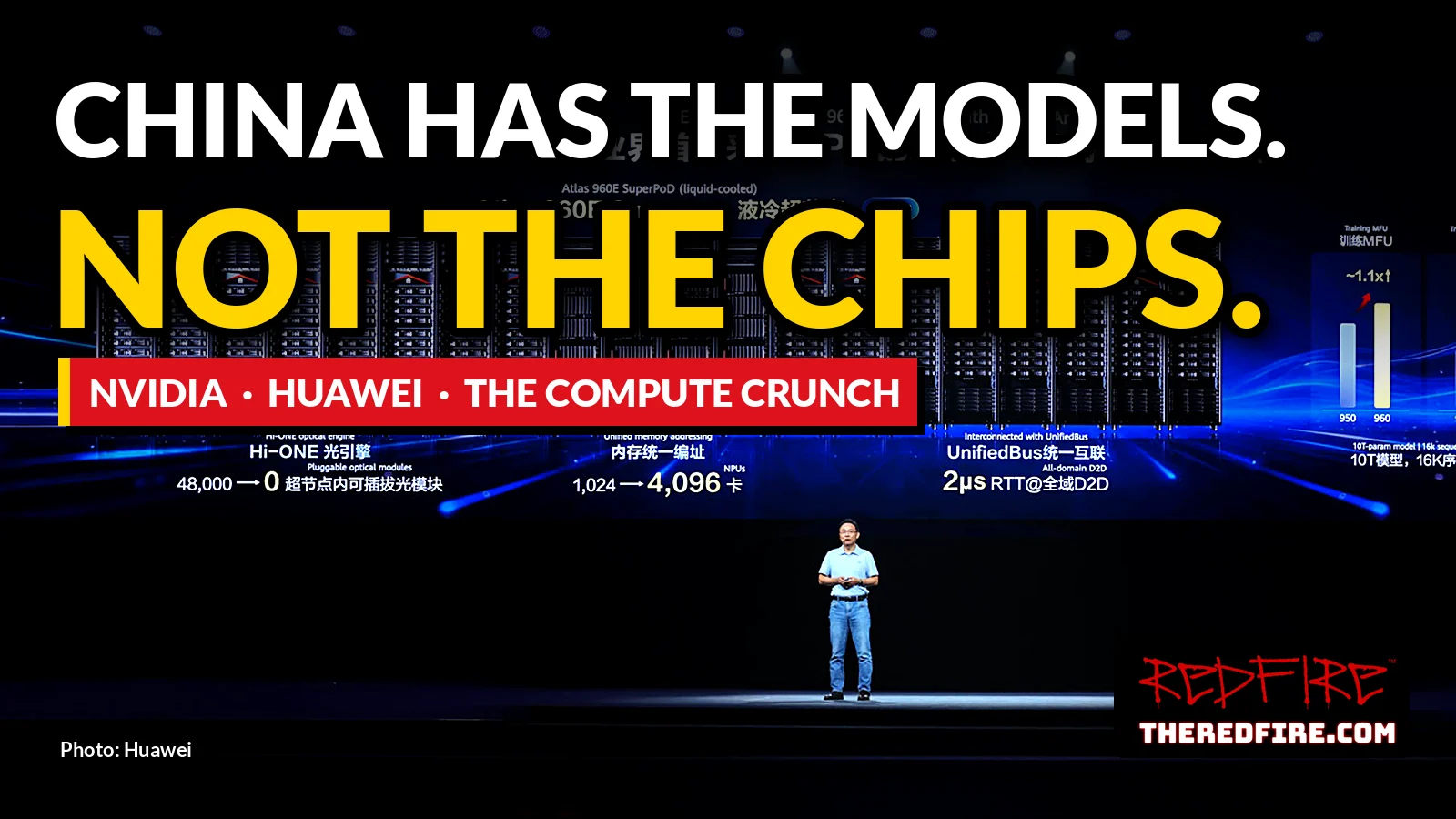
How Beijing’s computing crisis was built from both sides of the Pacific, and what it actually means for NVIDIA.
China is building the largest computing network on Earth. It is also rationing the chips that make that network useful.
That is the computing crisis. It is not a single shortage. It is three constraints stacked on top of each other: U.S. export controls that closed the front door, a Beijing industrial-policy decision that locked it from the inside, and a physical supply chain (logic wafers, high-bandwidth memory, advanced packaging, water, and power) that cannot yet replace what was cut off.
The live proof arrived this weekend. China’s Ministry of Industry and Information Technology (MIIT) asked Alibaba and ByteDance how many NVIDIA RTX Pro 5500 workstation cards they wanted to buy, and signaled that some of those purchases would be approved, according to The Information as reported by Reuters and CNBC. The RTX Pro 5500 is a Blackwell-generation professional GPU with 84 GB of memory. It is not an H200. It is not a GB300. It is not a training accelerator. Chinese labs will rack it because they cannot get the chip they actually want.
That is the crisis in one object.
The two-sided blockade
Washington started it. Beijing finished it.
The Bureau of Industry and Security (BIS) has, since 2022, steadily lowered the performance ceiling on what NVIDIA and AMD can ship to China. The A100 and H100 went first. The China-specific A800 and H800 followed. The H20, NVIDIA’s deliberately degraded China SKU, required a license from April 2025. Blackwell and Rubin remain under a presumption of denial. On May 31, 2026, BIS confirmed that it is enforcing a license requirement that dates to November 2023: licenses follow the ultimate parent company’s headquarters, not the loading-dock address. A Chinese AI lab cannot buy a Blackwell through a Malaysian subsidiary and call it a third-country sale.
President Trump then tried to reopen a narrower door. In January 2026, BIS moved H200 and AMD MI325X exports from presumption of denial to case-by-case review, with a volume cap of 50 percent of U.S. shipments, a 25 percent tariff, security certifications, and third-party testing. By May, Commerce had cleared roughly ten Chinese buyers, including Alibaba, Tencent, ByteDance, and JD.com, at up to 75,000 chips each, Reuters reported.
Almost none of that silicon entered the mainland.
NVIDIA’s own 10-Q for the quarter ended July 26, 2026, is unambiguous:
“The U.S. government, or USG, granted licenses that would allow us to ship small amounts of H200 products to specific China-based customers, but such sales were restricted by the PRC government, and we have been unable to sell all the products for which we have licenses.”
Shipments of Data Center Hopper products to China in that quarter were less than 1 percent of Data Center revenue. NVIDIA took a $400 million charge in the first half of fiscal 2027 for excess H200 inventory and purchase obligations. The earlier H20 episode was worse: a $4.5 billion inventory and purchase-obligation charge in the first quarter of fiscal 2026, against roughly $60 million of licensed H20 revenue.
Beijing’s reasons are not mysterious. The National Development and Reform Commission has drafted a five-year, 2 trillion yuan ($295 billion) national AI computing grid, with a mandate that at least 80 percent of the underlying technology, including accelerator chips, come from domestic suppliers. State-owned telecoms would operate most of it. The point of the plan is not to buy NVIDIA. The point of the plan is to stop needing NVIDIA.
The September 24 Trump–Xi meeting in Washington did not change this. The two sides agreed to lower tariffs on about $30 billion of consumer goods and left advanced semiconductor export controls untouched. Chip controls were treated as a national-security track, not a trade concession.
So the market NVIDIA actually faces in China is not “restricted.” It is dual-gated. Washington will not license the best chips. Beijing will not import the chips Washington would now license, except in tightly rationed drips, because importing them would starve Huawei.
Paper compute versus usable compute
On paper, China is not short of computing.
China Daily reported today that official intelligent-computing capacity reached 2,185 exaflops as of June 2026, up 177 percent year on year. More than 70 transmission corridors have been built and 17 regional interconnection nodes approved. The 15th Five-Year Plan folds the computing-power network into the national “six networks” infrastructure. The spatial design is “8+10+3”: eight national hubs, ten clusters, three computing-electricity coordination zones. In Inner Mongolia alone, 20 of the country’s 30 leading private computing firms have invested more than 200 billion yuan.
SemiAnalysis’s China datacenter model puts the installed fleet above 24 GW, larger than EMEA and larger than the rest of Asia, with another 20 GW of dated pipeline and 30 GW announced. Combined capital spending at Alibaba, Tencent, and Baidu reached about 132 billion yuan (roughly $19 billion) in the second quarter of 2026, and all three posted negative free cash flow.
That is construction. It is not training capacity.
The mismatch is now a feature of the system. High-end clusters at Alibaba Cloud, Tencent Cloud, and Huawei Cloud remain scarce. Newly built local “intelligent computing centers” have been reported running at 20 to 30 percent utilization. A 1,000-GPU rack with a weak interconnect and a crude scheduler delivers less throughput than a well-tuned 200-GPU cluster. CUDA is still the production standard. Domestic software stacks are usable. They are not free.
The on-the-ground symptoms are specific:
- In July, Moonshot AI paused new consumer subscriptions to Kimi days after launching Kimi K3, saying demand had pushed its compute cluster close to maximum capacity. Sign-ups did not reopen until September 18.
- In March, Tencent raised prices on its Hunyuan 2.0 model by more than 450 percent. Alibaba Cloud and Baidu raised some cloud prices by as much as 34 percent in April.
- DeepSeek founder Liang Wenfeng has said that the gaps in talent, model capability, and applications “can be attributed to differences in compute resources,” and that the biggest models run about 800 billion active parameters while domestic ones are “still at tens of billions.”
Official capacity of 2,185 exaflops and a lab that had to stop taking new subscribers can both be true. One is a government statistic. The other is a production constraint.
The four physical bottlenecks
Logic. SMIC, China’s leading foundry, is stuck at 7-nanometer-class production using deep-ultraviolet multi-patterning. It does not have EUV lithography. Yields on the leading node are widely estimated in the 30 to 40 percent range. Huawei’s Ascend dies are designed around that constraint. Quantity can compensate for quality only up to a point.
High-bandwidth memory. This is the binding constraint. An AI accelerator without HBM is a heater. ChangXin Memory (CXMT) is targeting HBM3 and HBM3E, with mass production still unproven at scale. SK Hynix, Samsung, and Micron are already shipping HBM4. The United States has banned HBM sales to China. Huawei’s 2025 production leaned on stockpiled and smuggled foreign HBM, and Epoch AI models that stockpile as fully spent in 2026.
Packaging. CoWoS-class advanced packaging is concentrated at TSMC. China’s domestic alternatives exist. They do not exist at the volume or yield the national grid assumes.
Power and water. Data-center electricity demand in China is projected to rise sharply through 2030. The policy answer is “computing-electricity synergy” and East Data, West Compute: put the racks where the wind and coal are. The geographic paradox is that those same western provinces are water-stressed. About 70 percent of China’s data-center capacity sits in water-scarce regions. Evaporative cooling and arid aquifers do not coexist indefinitely. Utilization at some western intelligent-compute centers has been reported below 30 percent, with operating costs that do not match the occupancy.
Huawei is the national champion that is supposed to close all four gaps. It has not.
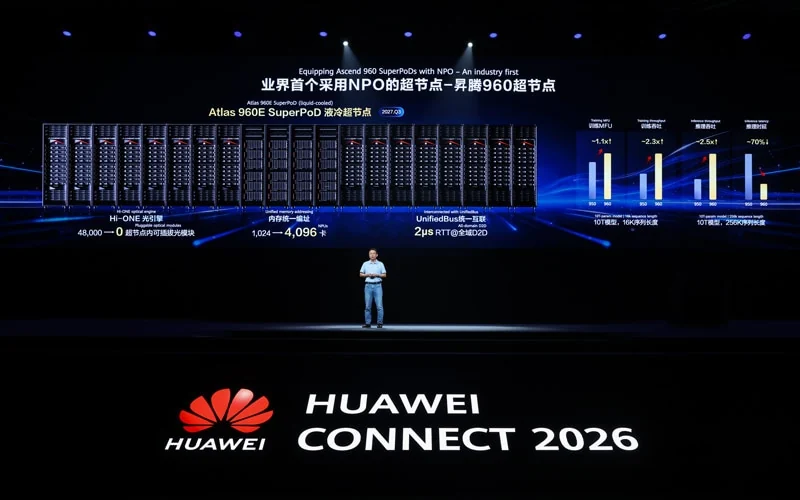
Rotating chairman Eric Xu said on the sidelines of Huawei Connect in Shanghai on September 17 that the company “does not have enough capacity to even satisfy the demand in China” and has “no plan to expand into the international market in a fully-fledged way,” Reuters reported.
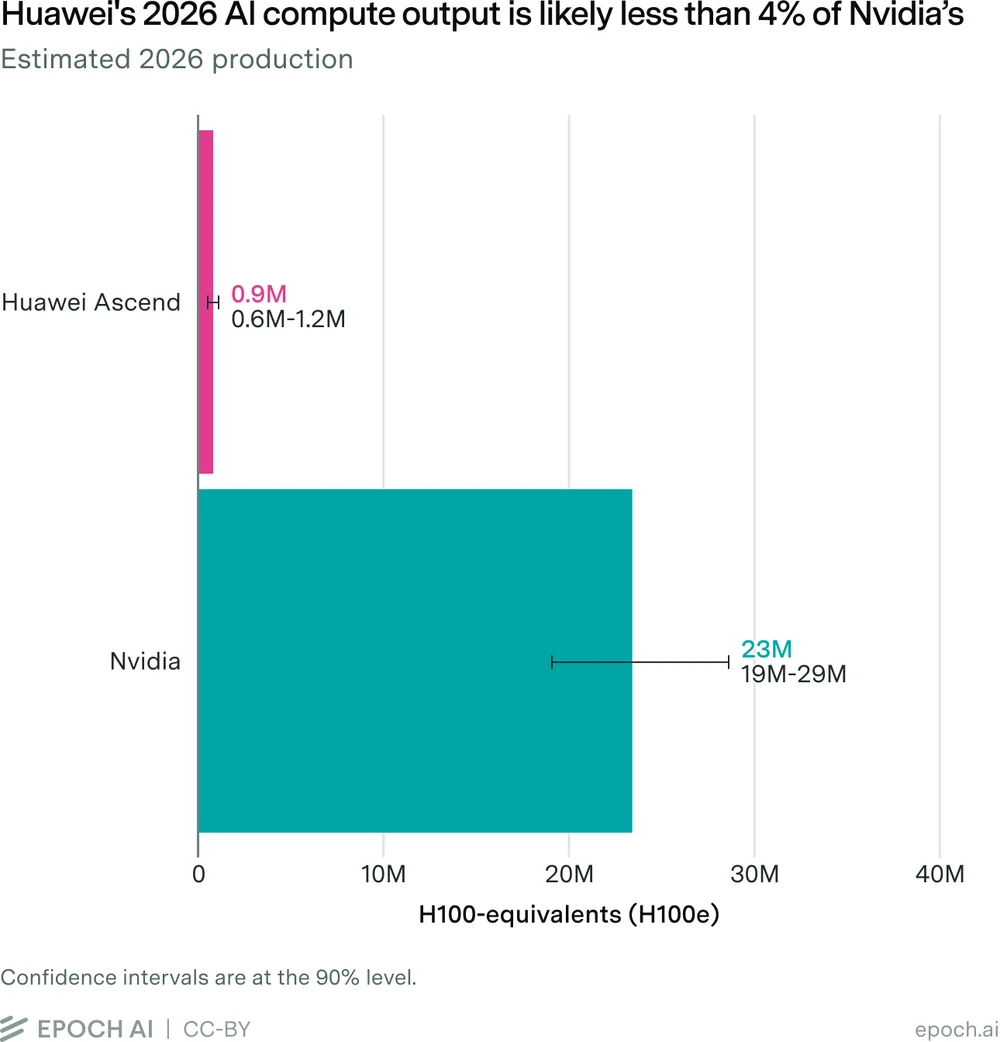
Epoch AI’s September 24 update estimates Huawei will produce about 1.5 million Ascend units in 2026, or roughly 880,000 H100-equivalents of compute. NVIDIA is estimated to ship 5.9 million chips in the same year, translating to about 23 million H100-equivalents. Huawei’s best current commercial part, the Ascend 950, delivers roughly half the arithmetic of an H100 that began shipping in 2022. The American Enterprise Institute’s (AEI) Voltcraft model puts 2026 Chinese AI compute demand at about 3,600 MW against Huawei supply of about 780 MW, a 5-to-1 shortfall.
Xu also claimed Ascend’s China share already exceeds NVIDIA’s. Bernstein’s published estimate is more cautious: NVIDIA’s China AI-chip share fell from about 40 percent in 2025 to about 8 percent in 2026, with Huawei rising toward 50 percent. Both numbers can be directionally right. Neither number means Huawei has caught NVIDIA. It means NVIDIA was evicted, and Huawei inherited the vacancy.
What this does to NVIDIA: the numbers first
NVIDIA does not need China to print a record quarter. That is no longer an opinion. It is the company’s guidance.
Here is what NVIDIA reported for the second quarter of fiscal 2027, which ended July 26, 2026:
- Revenue of $96.2 billion, up 106 percent year on year
- Data Center revenue of $89.0 billion, up 117 percent
- Gross margin of 75.0 percent
- China revenue (including Hong Kong, by customer headquarters) of $7.88 billion, about 8 percent of the total
- Third-quarter outlook of $108.0 billion, plus or minus 2 percent, “not assuming any Data Center compute revenue from China”
That $7.88 billion is not a data-center compute business. Data Center Hopper shipments to China were less than 1 percent of Data Center revenue, and NVIDIA can still sell gaming and workstation GPUs that fall outside the controls.
For the fiscal year ended January 25, 2026, NVIDIA booked $19.7 billion from China-headquartered customers out of $215.9 billion in total revenue, or about 9 percent. That figure is headquarters location, not end use. NVIDIA itself estimates that 76 percent of fiscal 2026 Data Center revenue from Taiwan-headquartered customers went to end customers in the United States and Europe. Geographic tables overstate and understate China at the same time. The clean statement is the one in the 10-Q: Data Center Hopper shipments to China are less than 1 percent of Data Center revenue, and the outlook assumes zero.
The stock, about $225 at Friday’s close and about $5.4 trillion of market capitalization, trades as a company that has already digested this. Jensen Huang has said the quiet part in public. NVIDIA once had “90-some odd percent” market share, he said in an April interview, and “in China, we have now dropped to zero.” He has also said the policy “has already largely backfired,” because conceding a market the size of China incubates a competitor.
Both things are true at once.
Near-term earnings. China is optionality, not oxygen. A $108 billion quarter that assumes zero China data-center compute does not miss because Beijing keeps the H200 faucet closed. If MIIT approves RTX Pro 5500 volumes, that is incremental workstation revenue: useful, not thesis-changing. If Beijing ever licenses a meaningful H200 tranche, NVIDIA has inventory and a supply chain that can restart. Neither event is in the $108 billion number.
The charge sheet already taken. $4.5 billion on H20. $400 million on H200. Those are recognized. They are not hanging over the next print.
The strategic loss. This is the real cost, and NVIDIA’s own filing language is more honest than most coverage. From the risk factors in the second-quarter fiscal 2027 10-Q:
“we were effectively foreclosed from competing in China’s data center computing/compute market, and our effective foreclosure from the China market helped our competitors build larger developer and customer ecosystems to challenge us worldwide.”
That sentence is the investment case in miniature. The 2026 income statement does not need China. The 2030 competitive map might.
The software moat inside China. CUDA is still how Chinese frontier labs train. Domestic alternatives such as Huawei CANN and various abstraction layers are improving. Migration cost is measured in engineer-years, not purchase orders. That is why even labs that publicly champion domestic silicon still run mixed clusters, and why some of the largest Chinese models continue to be trained, at least in part, on NVIDIA hardware that arrived through stockpiles, third countries, or the remaining legal channels. Export-control enforcement against smuggling has tightened. It has not gone to zero. In March 2026, U.S. prosecutors charged a Super Micro co-founder and two others with diverting about $2.5 billion of servers built with NVIDIA chips to China through Southeast Asia.
The 2028–2030 question. AEI’s end-to-end supply-chain model says Huawei could meet about a third of China’s compute demand by 2028 in a pessimistic case, and more than half if memory and packaging ramp. Epoch’s per-chip and volume math says Huawei remains a small fraction of NVIDIA’s global compute output through this year. Both can be right. The risk for NVIDIA is not that Huawei outships Blackwell in 2026. The risk is that a protected, good-enough, cheaper inference stack, trained on whatever mix of Ascend, smuggled Hopper, and workstation GPUs China can assemble, gets exported along the Digital Silk Road into markets that would otherwise have bought NVIDIA. That is a second ecosystem. It is not a 2026 revenue miss.
Antitrust residue. China’s State Administration for Market Regulation (SAMR) issued a September 2025 preliminary finding that NVIDIA violated conditions attached to its 2020 approval of the Mellanox acquisition. The case has been in and out of summit readouts. Until SAMR publishes a closure notice, it is a live legal risk to NVIDIA’s networking business in China, not a resolved footnote.
What Beijing is signaling this week
The RTX Pro 5500 story is easy to over-read.
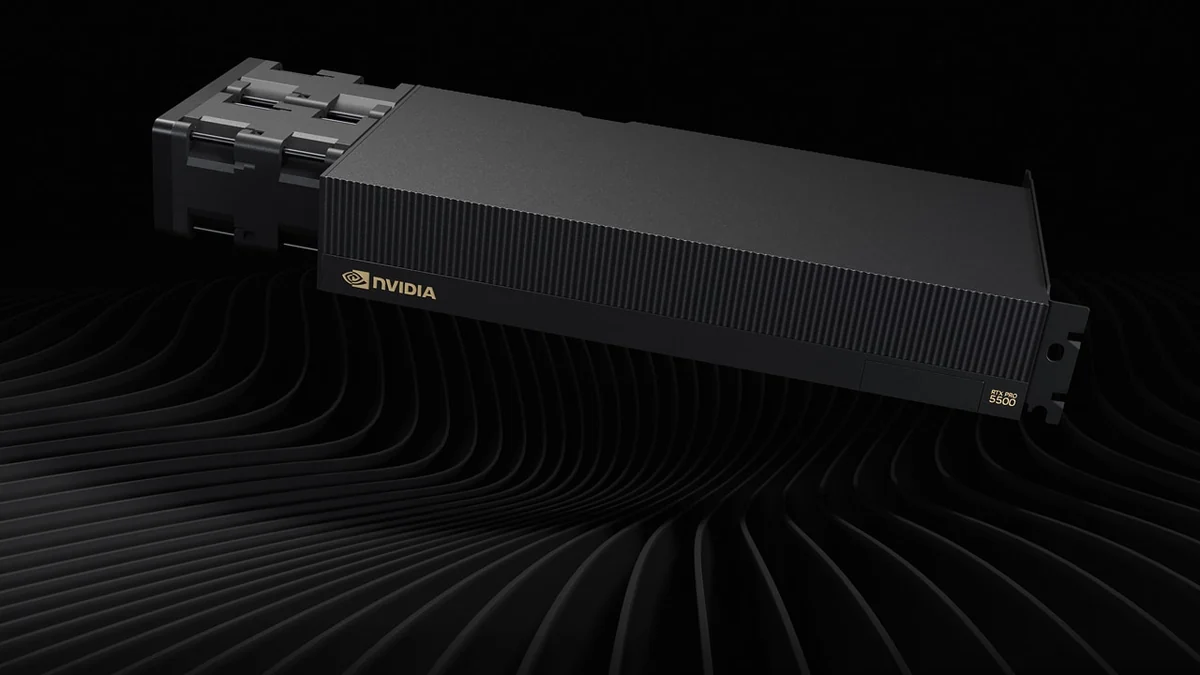
What it is: a workstation GPU that industry executives expect to sit outside the tightest U.S. data-center controls, which MIIT may allow Alibaba and ByteDance to import because domestic supply cannot keep up. Reported China pricing is 85,000 to 90,000 yuan per card, roughly $12,000 to $13,000. NVIDIA has been described as planning late-December shipments at about 500,000 units a quarter if the channel opens. ByteDance has been described as considering a large order. None of that is a signed contract. Reuters has not independently verified The Information’s account. NVIDIA’s spokesperson, asked to comment, said U.S. firms remain restricted by “a combination of outdated U.S. export controls, which cover gaming products released nearly a half a decade ago, and China’s own limits on U.S. imports.”
What it is not: a reopening of the China data-center market. Cambricon, Moore Threads, Hua Hong, and SMIC shares fell on Monday because substitution-trade investors treated the headline as a crack in the domestic-champion story. That reaction is about sentiment, not about GB300s arriving in Shanghai.
The honest read is narrower and more important. Beijing will protect Huawei on the chips that define frontier training. It will blink on the chips that keep inference products from falling over. That is industrial policy under shortage, not a strategic reversal.
What we are not claiming
This analysis has limits, and they matter as much as the numbers:
- We are not claiming NVIDIA “needs” China to hit its 2026 or 2027 numbers. The filings say the opposite.
- We are not claiming Huawei has caught NVIDIA on per-chip performance or on global compute output. The public roadmaps and third-party production models say it has not.
- We are not treating China’s official 2,185-exaflop figure as comparable to U.S. frontier-cluster quality. Generation, interconnect, software, and utilization are different things.
- We are not converting Jensen Huang’s “$50 billion China AI market” remark into current NVIDIA revenue. That is an addressable-market comment, not a booking.
- We are not asserting that the RTX Pro 5500 approvals have happened. They have been reported as under review.
- We are not predicting an 89 percent crash in U.S. AI stocks, a Chinese compute bubble collapse, or a sudden Huawei export wave. Those are other people’s headlines.
The shape of the next two years
China will keep pouring concrete. The national grid will add corridors, hubs, and official exaflops. Some of those buildings will be full. Some will be stranded: racks without the right chips, chips without the right memory, clusters without the interconnect or the software to make the paper number real.
NVIDIA will keep selling every Blackwell and Rubin it can make to customers who can legally take them. The constraint on NVIDIA’s income statement is TSMC capacity, HBM, and CoWoS, not Beijing. The constraint on NVIDIA’s decade is whether a second, state-protected stack becomes good enough to matter outside China.
The computing crisis is real. It is also, for now, NVIDIA’s already-taken write-down, and Huawei’s unfinished assignment.
Answers
Can NVIDIA sell AI data-center chips in China right now?
Only in trickles. The U.S. licenses H200 sales case by case, but NVIDIA’s latest 10-Q says the PRC government restricted those sales, and Data Center Hopper shipments to China were less than 1 percent of Data Center revenue last quarter.
What is the RTX Pro 5500 China story?
MIIT asked Alibaba and ByteDance how many NVIDIA RTX Pro 5500 workstation cards they plan to buy and signaled some approvals, according to The Information as reported by Reuters. Nothing has been confirmed as approved or shipped.
Does NVIDIA’s guidance include China?
No. NVIDIA’s $108.0 billion third-quarter fiscal 2027 outlook assumes no Data Center compute revenue from China.
Can Huawei replace NVIDIA in China?
Not yet at scale. Epoch AI estimates Huawei’s 2026 Ascend output at about 880,000 H100-equivalents, against about 23 million for NVIDIA, and Huawei’s Eric Xu says the company cannot meet demand in China.
Sources
NVIDIA primaries
- NVIDIA Q2 fiscal 2027 earnings release, August 26, 2026
- NVIDIA Form 10-Q for the quarter ended July 26, 2026 (H200 licenses, PRC restrictions, H20 and H200 charges, China data-center foreclosure, SAMR)
- NVIDIA Form 10-K for the fiscal year ended January 25, 2026
U.S. and Chinese policy
- BIS advanced-computing license-review rule, Federal Register, January 15, 2026 (H200 and MI325X case-by-case)
- BIS guidance on entities headquartered in Country Group D:5 and Macau, May 31, 2026
- Reuters, May 14, 2026 (H200 licenses for about 10 Chinese firms)
- Tom’s Hardware, citing Bloomberg, June 2026 ($295 billion national computing-grid plan, 80 percent domestic mandate)
- BBC and Foreign Policy, September 24, 2026 (Trump–Xi summit, chip controls not traded)
- China Daily, September 28, 2026 (2,185 EFLOPS, 8+10+3 layout, Inner Mongolia investment)
China supply and demand
- Reuters, September 17, 2026 (Eric Xu at Huawei Connect)
- Epoch AI, “Will Huawei catch up to Nvidia by 2030?”, updated September 24, 2026
- AEI Voltcraft working paper, July 2026 (3,600 MW demand vs. 780 MW Huawei supply)
- SemiAnalysis China datacenter model, September 2026
- AP via the Los Angeles Times, citing Bernstein, June 29, 2026 (China AI-chip share estimates)
- TechNode, July 20, 2026 (Kimi subscription pause)
- 36Kr, Pandaily, and ChinaTalk, June–July 2026 (utilization, pricing, East Data West Compute)
Industry and market
- CNBC, citing Reuters and The Information, September 27, 2026 (MIIT and the RTX Pro 5500)
- Investing.com and Aju Press, September 28, 2026 (Chinese chip stocks fall)
- Reuters, March 19, 2026 (Super Micro-related diversion charges)
- Tom’s Hardware, May 3, 2026, and Yahoo Finance, May 4, 2026 (Jensen Huang on China share)
- Rhodium Group, August 2026 (compute gap acknowledged by Alibaba, Zhipu, DeepSeek)
- ThinkChina, September 2026 (water stress, computing-electricity synergy)
- NVDA regular-session close, September 25, 2026: $225.07; market capitalization about $5.4 trillion
Also in The Brief: NVIDIA Just Posted $96.2 Billion. Next Quarter is $108 Billion. · SpaceX’s Space-Optimized NVIDIA Vera Rubin NVL72 for Orbit in 2027 · Tesla Grok Is Live in Israel and the UAE on 2026.32.6+
Come see tech in a new light.
The RED Review · theredfire.com · YouTube @TheREDReviewTech · X @TheREDReview_EV