
Sub-Total: $0.00
Post
Tesla Semi Deliveries Just Started. 500 Miles Loaded. $260K–$290K.
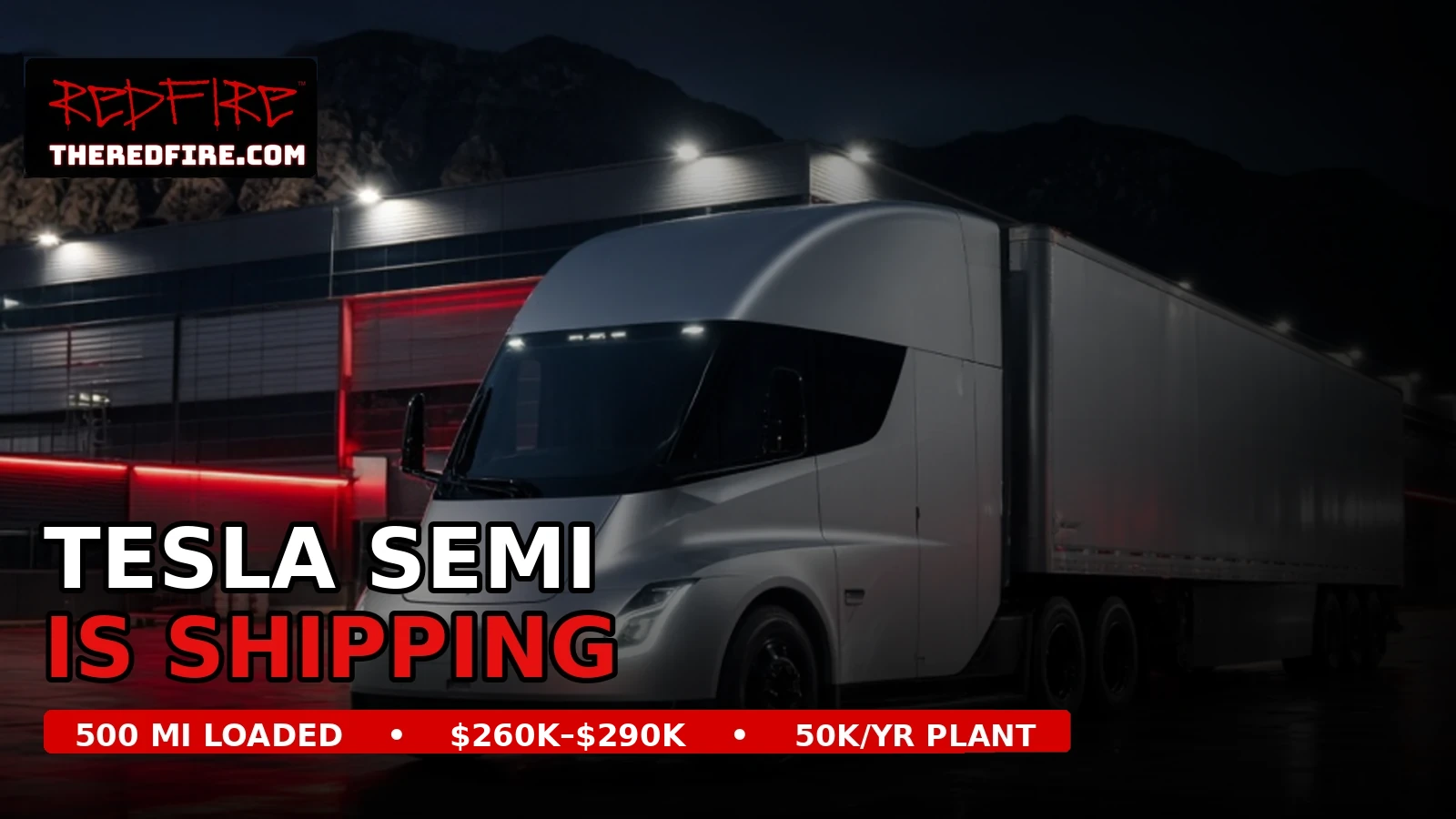
Thursday night in Sparks, Nevada, Tesla did the thing it put on a slide in 2017.
Not a concept. Not a hand-built pilot. High-volume Semi production is live at a dedicated factory next to Gigafactory Nevada, and Tesla says deliveries start now.
PepsiCo, DHL, and US Foods were invited on stage. Trucks wearing their logos sat outside. Elon Musk was not in the building.
Nine years after the Hawthorne unveil. Seven years after the original 2019 production date. That is the story.
The other story is what Tesla still refused to put on a slide.
What Tesla actually confirmed
Tesla Semi’s own account posted the factory numbers Thursday night. This is the first plant Tesla built for the truck.
Tesla called it 1.8 million square feet. Earlier factory tours had used 1.7 million. We’re using Tesla’s number, but you’ll see both in print.
Nameplate capacity is 50,000 units a year — about 1,000 a week if the line ever runs at that rate. Standard Range, Long Range, and European-spec trucks are supposed to come down the same line.
The first truck off that high-volume line rolled on April 29. Thursday was the public inauguration and the start of customer deliveries from that line, not the first time a Semi existed. Tesla has been handing limited pilot trucks to PepsiCo and others since late 2022.
Tesla’s July shareholder letter already dropped an earlier forecast that volume production would land in 2026 and said only that production would begin this year. Thursday’s language was “high volume” and “deliveries start now.”
Tesla did not say how many trucks leave Sparks this week, this month, or this year. Outside estimates published Thursday still sit in a 5,000-to-15,000 delivery band for 2026. That is not Tesla’s number. It is the gap between a 50,000-unit factory and a line that just had a party.
Range, efficiency, and charging
Two U.S. trims, both rated at a full 82,000-lb gross combination weight:
- Long Range: 500 miles
- Standard Range: 325 miles
Dan Priestley, Tesla’s director of Semi truck engineering, did not hedge the loaded number. “That’s 500 real-world miles. Our customers have validated it.”
Lars Moravy, Tesla’s VP of vehicle engineering, who co-hosted the night, said a truck at about 60,000 lbs could reach around 600 miles. Treat 500 loaded as the number Tesla will be held to.
Consumption at the event: about 1.7 kWh per mile fully loaded, against the original 2,000 Wh/mile target.
Tesla’s public Semi page now lists the same 1.7 kWh per mile for both trucks, next to 325 and 500 miles of range and up to 60 percent of range in 30 minutes. The price: $260,000 for the Standard Range and $290,000 for the Long Range. More on that below.
Tesla did not publish a new pack size Thursday. An April CARB filing still on the books listed 822 kWh usable for Long Range and 548 kWh for Standard Range, both 4680 NCMA.
Long Range peak drive power in that filing is 800 kW. Standard Range is 525 kW. So 800 kW is the Long Range number, not both trucks.
Charging is the Megacharger. Tesla’s Semi page says a Megacharger, at up to 1.2 MW, can add up to 60 percent of range in 30 minutes.
That window is built to fit a federal Hours-of-Service break. A live megawatt-class charge was part of the webcast. Tesla also talked up a lower-power Basecharger for overnight depot use.
What Tesla still has not published is a public map with enough stalls to make a national long-haul network real. TechCrunch’s Friday piece, citing a person familiar with the matter, said charging infrastructure remains a hurdle.
What the night did not include: a current build rate, a 2026 delivery target, or a dated FSD (Supervised) promise for the truck.
Who is taking the trucks
On stage, Reuters named PepsiCo, DHL, and US Foods. Event recaps and drone footage also put WattEV, ABF (ArcBest), Einride, IMC, OK Produce, and LTS trucks on the lot.
PepsiCo is not new. It took the first hand-built pilots in late 2022 and has been running dozens of them since — at least 50 in California by recent counts. Axios puts the whole early fleet at about 200 trucks since 2022.
Tesla Semi’s own account said 2026 year-to-date uptime is over 98 percent. That is Tesla’s number from a small fleet. It is not a 50,000-truck reliability curve.
Einride announced a 500-truck order in August. IMC said this week it is buying 50 for California drayage. ArcBest bought two trucks in June after a 2025 pilot that logged about 1.55 kWh per mile.
DHL has already taken trucks. Tesla also said it will run Semis on its own freight.
Separately, Forum Mobility has said 25 carriers reserved capacity for more than 330 Semis at one Southern California depot. That is offtake at a depot, not Thursday’s stage list.
The 2,500-truck order: primary, not exclusive
The bigger number landed Tuesday, not on stage.
ZET SCALE — Zero-Emission Truck Shipper-Carrier Alliance Leading Electrification, run by Catalyst Mobility and the Smart Freight Centre — named Tesla the primary OEM on a 2,500-truck battery-electric Class 8 order. Founding shippers include Microsoft and PepsiCo.
Catalyst called it the largest electric Class 8 order in the U.S. to date and said it would nearly double the existing U.S. electric Class 8 fleet. The first 2,500 trucks are spread across 10 freight hubs. The alliance’s longer target is 10,000 trucks or more.
Read the fine print. Primary OEM is not exclusive OEM. Kenworth, Volvo, and RIDE are secondary suppliers.
Catalyst did not say how many of the 2,500 will be Semis. Tesla’s own account framed it as 2,500 Semis on order. The alliance’s paperwork does not.
So it’s not accurate to say “Tesla just sold 2,500 Semis.” Here’s what it is: Tesla won the lead slot on the largest electric Class 8 buy of the year, and the order book is no longer theoretical.
Also from the night
Musk skipped the factory. He was in Washington for the Trump-Xi state dinner and sent a tape.
The quote that matters: “I’d recommend placing more orders if you haven’t already, but the waiting list is already pretty significant.” He also called it the funnest truck to drive.
Priestley said the ramp brings more than 3,000 jobs.
At the end of the night Tesla teased the Roadster reveal for October 1. That is a different story, for another day.
The hardware Tesla actually redesigned
This is the owner-relevant part if you already live in Cybertruck and Cybercab hardware.
Tesla Semi’s Thursday thread is the source, not a rumor mill:
- Weight. About 1,000 lbs came out of the truck versus the early design. Payload parity with diesel is the point.
- 4680 cells. In-house 4680 cells replaced the 2170s from the PepsiCo pilots. Tesla’s line: less battery mass, fewer kilowatt-hours, no compromise on range.
- Steel-caged rotor. It replaced the carbon-fiber-sleeved rotor. Tesla says it is cheaper, more reliable, and more efficient. Drive-axle oils went from three types to one.
- Bar-wound stator. It is shared with Cybertruck.
- Electric steering. Semi is the first heavy-duty truck with fully electric steering. No hydraulic pump. No hydraulic fluid. Tesla’s words: lighter, quieter, more precise, redundant by design, and “groundwork for future autonomy.”
- Megamanifold heat pump. It runs cabin HVAC and every powertrain heating and cooling loop. Waste heat from the motors and pack warms the cab. No refrigerant lines running forward through the chassis. Tesla says the same thermal architecture is on Cybercab.
- Powder coat and in-house parts. Tesla calls it the first powder-coated Class 8 truck. The plant stamps its own metal and builds its own batteries, drive axles, high-voltage distribution, cooling modules, and seats. Most truck plants only assemble.
And the most RED Review sentence of the night: Priestley admitted the original pop-out windows were a miss. The production truck has roll-down windows.
“We fully admit we were wrong about the windows.”
If you have ever owned a Tesla that shipped a cute idea and then walked it back, that line will feel familiar.
The price, and the number Tesla will not publish
The Tesla Semi costs $260,000 for the Standard Range and $290,000 for the Long Range. Tesla did not put that on a slide Thursday, and Priestley declined to discuss it on the factory floor. But that is the number fleets are being quoted.
The 2017 slide said $150,000 for the 300-mile truck and $180,000 for the 500-mile truck. Those numbers are museum pieces.
Electrek obtained a customer quote showing $290,000 for the Long Range before destination and taxes, and reported Friday that Tesla has been quoting about $260,000 for the Standard Range. TechCrunch’s Friday recap put the top truck “just shy of $300,000 before incentives.”
Those are quote prices, before destination fees, taxes, and incentives. In California, the base HVIP voucher for a Class 8 truck is $120,000, so the check a fleet actually writes can be a lot smaller.
For a Model Y buyer, price is one line on the sticker. For a fleet, it is the product. Class 8 trucks get bought on cost per mile: truck, energy, maintenance, residual, driver hours, downtime.
Tesla can show 500 loaded miles and 1.7 kWh/mi all night. With a $260,000-to-$290,000 truck, a CFO can finally build the model. Without a published 2026 volume, they still cannot close it.
The energy math Tesla put on a chart Thursday is the part that actually moved. Axios recap: diesel recently running about 80 cents a mile, electricity 20 to 30 cents a mile.
EIA’s weekly U.S. on-highway diesel for the week of September 21 printed $6.529 a gallon — a record in that series, about $2.78 above a year ago.
At $3 or $4 diesel the electric truck is a hard sell. At $6.50 diesel the spreadsheet changes. The Semi’s cost case did not get easier because Tesla built a factory. It got easier because diesel got worse.
What this means if you actually own Teslas
This is not a Cybertruck accessory drop. It is the first Tesla product that has to beat diesel on math or it dies.
If you were waiting for “is the Semi real?” the answer is now yes.
The dedicated factory exists. Tesla says high-volume production is launched. Customers are taking trucks this week. The pilot fleet already has years and millions of miles on it.
If you were waiting for “should a fleet order one tomorrow?” you now have one of the two inputs that decide that: the price, $260,000 for the Standard Range and $290,000 for the Long Range. The other, a public build rate, Tesla still has not given you.
Charging is the other risk. A 30-minute, 60-percent Megacharge is the right idea for Hours-of-Service. A corridor map with gaps is not a network yet.
The short version
Tesla Semi high-volume deliveries started the week of September 24, 2026, from a new factory in Sparks, Nevada, that Tesla calls 1.8 million square feet. The numbers that matter:
- 500 real miles fully loaded and customer-validated, with 325 miles on the Standard Range pack
- About 1.7 kWh per mile, now listed on Tesla’s Semi page too
- 50,000 trucks a year of claimed capacity, but no current rate
- A 2,500-truck Class 8 coalition order with Tesla as primary OEM, not exclusive
- An early fleet of about 200 trucks, with Tesla-claimed 98 percent-plus uptime
- $260,000 Standard Range, $290,000 Long Range, but no 2026 volume number
- Diesel that just printed $6.53 a gallon
Nine years later, the hardware is on the lot. The spreadsheet still has a blank cell.
Come see tech in a new light.
The RED Review · theredfire.com · YouTube @TheREDReviewTech · X @TheREDReview_EV