Sub-Total: $0.00
Post
Does New York’s new car subscription law cover FSD (Supervised)?
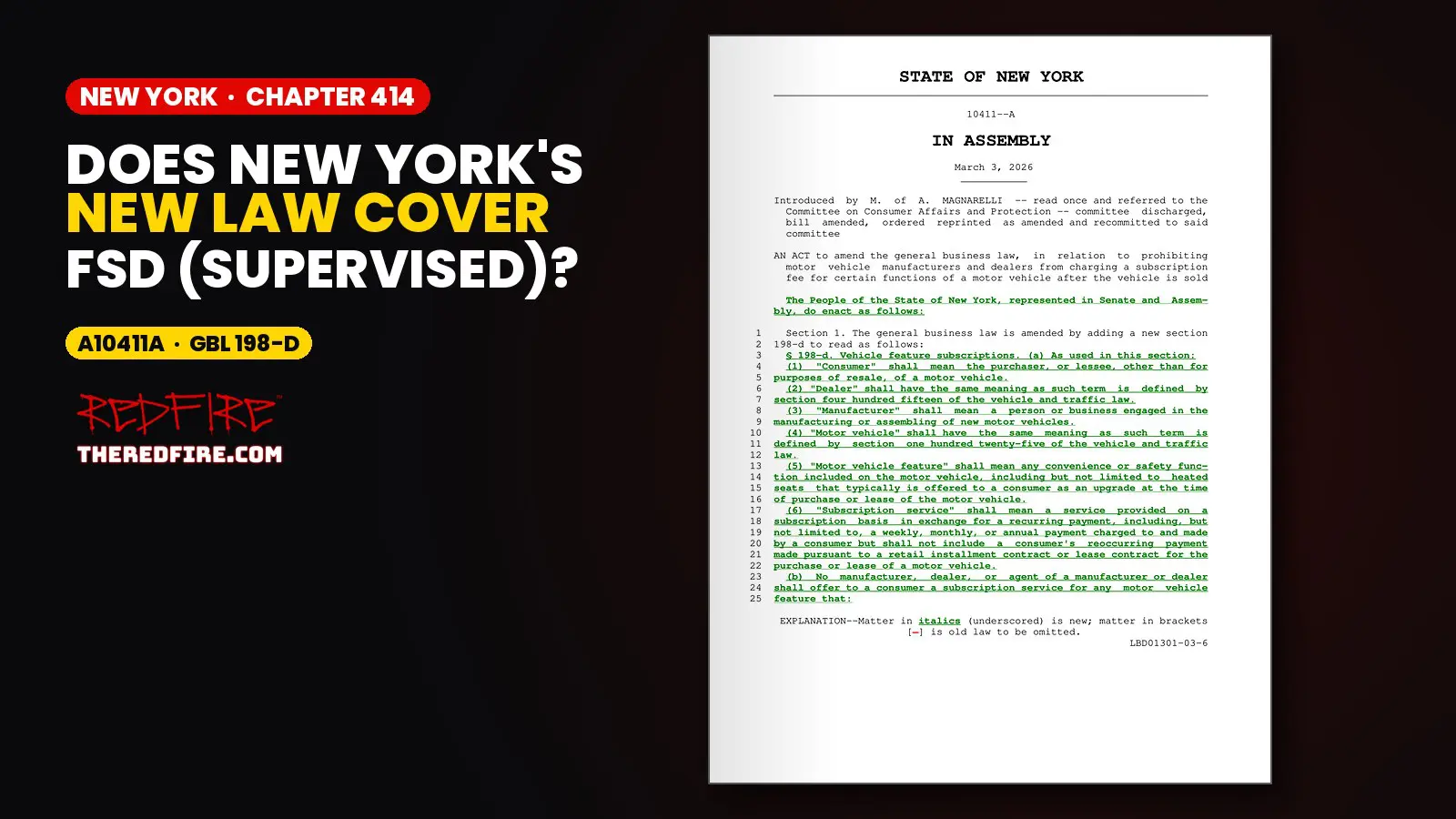
New York’s new car subscription law bars a manufacturer, dealer or their agent from offering a recurring fee for a feature that uses hardware already installed in the car and that would work after activation without ongoing cost or support. The signed statute expressly does not apply to “software-dependent driver assistance or driver automation features,” and it does not name Tesla or FSD (Supervised). On our reading of that text, FSD (Supervised) subscriptions appear to fall outside the ban. That is our reading of the law, not a position Tesla has stated.
Governor Kathy Hochul signed the measure, S.9348A / A.10411A, on Nov. 23, 2026, as Chapter 414 of the Laws of 2026, according to the New York Senate and Assembly bill records. The act adds section 198-d, “Vehicle feature subscriptions,” to the state’s General Business Law.
What does New York’s new law ban?
The prohibition is in subdivision (b). No manufacturer, dealer, or agent of a manufacturer or dealer “shall offer to a consumer a subscription service for any motor vehicle feature that: (1) utilizes components and hardware already installed on the motor vehicle at the time of purchase or lease by the consumer; and (2) would function after activation without ongoing cost to or support by the dealer, manufacturer, or any third-party service provider.”
Both tests have to be met. A “motor vehicle feature” is “any convenience or safety function included on the motor vehicle, including but not limited to heated seats that typically is offered to a consumer as an upgrade at the time of purchase or lease of the motor vehicle.” A “subscription service” is a service provided in exchange for a recurring payment, such as a weekly, monthly or annual charge. Payments under a retail installment contract or a lease contract for the car itself are not counted as a subscription.
Here’s an example of the kind of fee the law covers. In July 2022, BMW’s ConnectedDrive store in the United Kingdom began offering a £15-a-month subscription to switch on heated front seats already fitted in the car, the BBC reported. The Verge put the price at about $18 a month depending on the market and found the offer in Germany, New Zealand, South Korea and South Africa too. A BMW spokesperson said it never came to the United States. BMW had dropped it by September 2023. Pieter Nota, then its board member for sales and marketing, told Autocar that “the user acceptance isn’t that high” and that seat heating would be factory-fitted or not: “It’s either in or out.” New York’s law, in General Business Law section 198-d(b), covers a recurring fee for a feature that “utilizes components and hardware already installed on the motor vehicle at the time of purchase or lease by the consumer.”
The governor’s office also described the law as restricting “post-purchase fees.” The signed definition is narrower than that phrase. On the face of the text, the ban is written for recurring subscriptions, not for a one-time fee to turn a feature on.
When does the law take effect?
Section 2 of the signed print says, “This act shall take effect on the ninetieth day after it shall have become a law.” The Senate and Assembly action tables record the signing as Nov. 23, 2026. Counted from that date, the ninetieth day is Feb. 21, 2027.
The governor’s office, in a Nov. 23, 2026, release, said the law “will take effect in 90 days on February 27, 2027.” The bill text does not state a calendar date. Feb. 27, 2027, is 96 days after the Nov. 23 signing recorded on the bill pages. Until a chapter slip or later official notice sets a calendar date, the statutory wording is the rule, and the Feb. 27 date should be attributed to the governor’s office.
Does the exemption cover FSD (Supervised)?
Subdivision (c)(1) says the provisions of the section shall not apply to a list of services. The signed text names these categories:
- Navigation system updates
- Infotainment features
- Satellite radio
- In-vehicle Wi-Fi
- Telematics services
- Roadside assistance
- Software-dependent driver assistance or driver automation features
The same subsection also excludes “vehicle-connected services that rely on cellular or other data networks for continued operation.” A further clause says a company may still provide software updates, but may not charge for a safety-defect update that federal recall rules already require to be free.
The law does not name Tesla, FSD (Supervised), Autopilot or any other automaker’s driver-assist brand. The phrases “software-dependent driver assistance or driver automation features” and “vehicle-connected services that rely on cellular or other data networks” are not defined further. On our reading of that exemption, a paid FSD (Supervised) subscription appears to fall outside the ban. That is a reading of the text, not a Tesla confirmation, and not a ruling by a court or by the Department of State. For the current FSD (Supervised) software rollout, see Redfire’s report on Tesla Starts Rolling Out FSD (Supervised) V15.
The governor’s Nov. 23 release said the law “guards against” fees to activate built-in features “like heated seats, enhanced navigation, hands-free driving and entertainment options.” Heated seats are the example written into the statute’s definition of a motor vehicle feature. “Hands-free driving,” “enhanced navigation” and “entertainment options” are press language. They sit uneasily next to the statutory exemptions for software-dependent driver assistance or driver automation features, navigation system updates, and infotainment features. The exemption list in the signed text is the legal test, not the examples in the release.
What are the penalties?
A manufacturer, dealer or agent that fails to comply “shall be assessed a civil penalty not to exceed two hundred fifty dollars per point of sale for each violation.” The Department of State “may promulgate such rules and regulations as are necessary to effectuate and enforce the provisions of this section.”
The signed text does not create a private right of action, a criminal penalty or an attorney-general enforcement duty. “Point of sale” is not defined.
What should New York Tesla owners expect?
The statute does not tell an individual owner to cancel a plan, file a complaint or wait for a refund. Here is what New York Tesla owners should and should not expect, based on the signed text:
- Do not assume an FSD (Supervised) subscription will become free. The statute exempts software-dependent driver assistance or driver automation features and does not name Tesla.
- Read the exemption list in the statute, not the “hands-free driving” example in the governor’s press release.
- Wait for Department of State rules before treating any Tesla feature as newly covered or uncovered.
- Treat the ban as a rule about recurring subscriptions, not as a clear ban on one-time unlock fees.
- Do not assume the law changes anything for owners outside New York. It defines a consumer as a purchaser or lessee, other than for resale, of a motor vehicle, and it does not say it applies beyond the state.
The text also does not say what happens to a subscription that began before the effective date. This article is based on the signed New York text and the governor’s office release. It does not rely on a Tesla statement.
Also in The Brief: Redfire’s earlier report on whether the midterms could bring back the EV tax credit.
FAQ
When does New York’s car subscription law take effect?
The statute takes effect on “the ninetieth day after it shall have become a law.” Counted from the Nov. 23, 2026, signing date on the bill pages, that day is Feb. 21, 2027. The governor’s office said Feb. 27, 2027.
What is the penalty for violating the law?
The civil penalty is not to exceed $250 per point of sale for each violation. The Department of State may write rules to enforce the section. The text does not create a private right of action.
Does the law ban a one-time fee to turn on a feature?
The ban is written for a “subscription service,” which the statute defines as a recurring payment. It does not, by its terms, ban a one-time unlock fee.
Does the law apply only to new cars bought in New York?
The text doesn’t say. It bars offering a covered subscription to a “consumer,” defined as a purchaser or lessee other than for resale, and it doesn’t say “new cars only” or what happens to plans that started before the effective date.
Sources
- New York State Senate, Assembly Bill A10411A, signed chap. 414, Nov. 23, 2026
- New York State Senate, Senate Bill S9348A, signed chap. 414, Nov. 23, 2026
- Official print of A10411A (PDF)
- Official print of S9348A (PDF)
- Governor Kathy Hochul, “Money in Your Pockets: Governor Hochul Signs Bill Restricting Exploitative Vehicle Subscription Fees”, Nov. 23, 2026
- BBC, “BMW introduces new heated seat subscription in UK”, July 13, 2022
- The Verge, “BMW starts selling heated seat subscriptions for $18 a month”, July 12, 2022
- The Verge, “BMW drops plan to charge a monthly fee for heated seats”, Sept. 7, 2023
- Autocar, “BMW will not charge extra to activate existing functions in cars”, Sept. 7, 2023
- The Register, “BMW deems drivers worthy of warmth, ends heated car seat subscription”, Sept. 9, 2023
- Redfire, midterms EV tax credit report, Nov. 4, 2026
- Redfire, Tesla Starts Rolling Out FSD (Supervised) V15, Nov. 21, 2026