Sub-Total: $0.00
Post
California’s MyFirstEV Rebate: 5,658 Teslas Bought, Tesla’s Share Is Gone
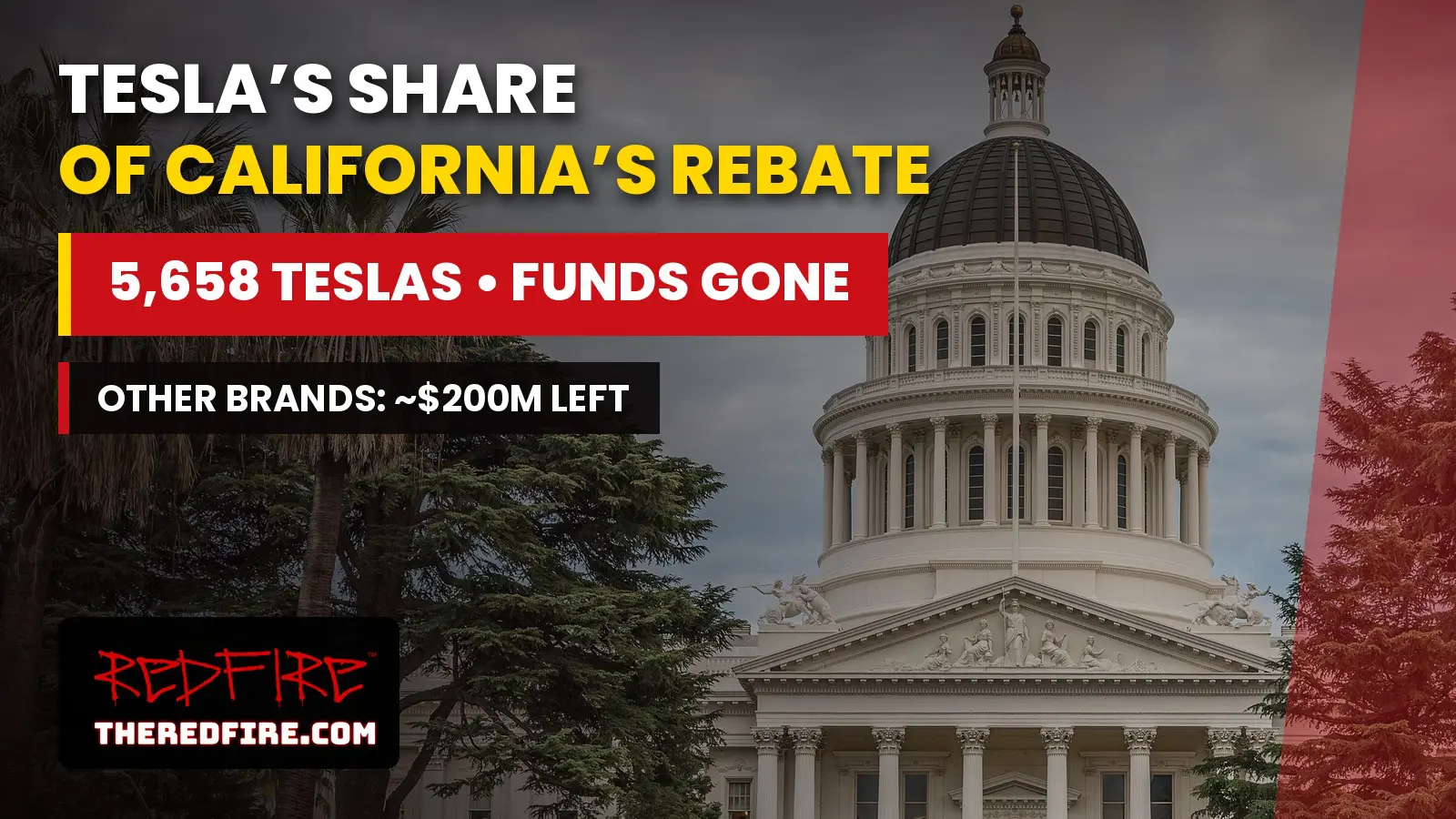
California said on Friday, Oct. 16, that nearly 12,000 first-time buyers have used its MyFirstEV rebate, and Reuters reported that 5,658 of them bought a Tesla. Tesla’s share of the money has been gone since early August, and the state’s own list still shows Tesla as closed. Other brands still have funds.
Is Tesla still eligible for California’s MyFirstEV rebate? No. The California Air Resources Board (CARB) lists Tesla as “Closed: Funds no longer available,” and Reuters reported on Friday, Oct. 16, 2026, that California said no funds remain for Tesla models. What ran out is Tesla’s share, not the whole program: the $3,500 rebate on a new EV (and up to $1,750 on a used one) is still offered through other automakers, according to the state. This is not new for Tesla. Its money ran out around Aug. 8, five days after launch, and the Oct. 16 update added the sales counts.
Key facts
These are the numbers California reported on Oct. 16, as carried by Reuters, plus the program rules from CARB:
- Nearly 12,000 buyers have used the rebate since August: 11,806 new EVs and 132 used EVs, according to Reuters.
- Tesla accounts for 5,658 of them, ahead of Hyundai at 1,700, Toyota at nearly 1,400 and General Motors at 1,100.
- About $70 million of the $270 million has been spent, leaving roughly $200 million, according to Reuters.
- The rebate is $3,500 off a new EV with an MSRP up to $50,000, or $1,750 off a used EV priced up to $25,000.
- The money is $135.5 million from the state and a matching $135.5 million from participating automakers.
- The program launched Aug. 3, 2026, and runs first-come, first-served until funding is gone.
By our math, Tesla’s 5,658 cars are about 47% of the 11,938 vehicles counted. That figure is ours, not the state’s.
What “Tesla’s share is gone” means
The rebate is not one shared pot. California’s money is split among the participating automakers, and each one matches it, so one brand can run dry while the others stay open. CARB’s participating manufacturers page, updated Sept. 25, shows 14 brands available, Mitsubishi launching in November, and one line for Tesla:
Tesla: Closed: Funds no longer available
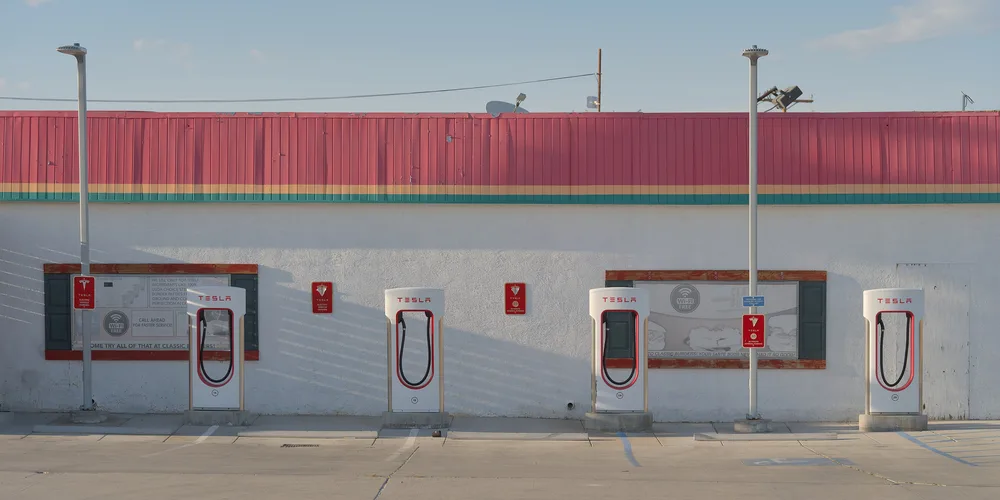
CARB’s chair, Lauren Sanchez, said on Aug. 11 that one automaker had already run out of funding, and a CARB spokesperson confirmed it was Tesla, E&E News reported. InsideEVs reported that Tesla had used up its allocation by Aug. 8, and that CARB told it the state’s $135.5 million is split equally among about 15 automakers, roughly $9 million each. With the match, that implies about $18 million for Tesla, which InsideEVs called an unofficial estimate. We did not find an official Tesla allocation. We also did not find a CARB statement on whether Tesla’s money could be reopened.

One number needs a caveat
Reuters reported about $70 million spent. By our math, 11,806 new EVs at $3,500 and 132 used EVs at $1,750 come to about $41.6 million in combined rebates. Reuters did not explain the gap, and we did not find a CARB breakdown. Treat the $200 million as the state’s overall remainder, not as money open to every buyer, because each automaker has its own allocation.
What this is not
It is not a Tesla-only program. Tesla, Hyundai, Toyota and General Motors lead the counts, and the Governor’s Oct. 16 release says rebates are still available through Ford, General Motors, Honda, Hyundai, Kia, Lexus, Toyota, Lucid, Nissan, Rivian, Subaru and Volvo.
It is also not an open-ended subsidy, and it is not the federal credit. The federal $7,500 new-vehicle credit and $4,000 used-vehicle credit ended for vehicles acquired after Sept. 30, 2025, the IRS says, under the law signed July 4, 2025. For market context, the California Energy Commission reported that zero-emission vehicles were 19.1% of new car sales in the third quarter of 2026, with fully electric cars at 16.3%.
What first-time EV buyers in California should do
Here is the order to follow before you count on the rebate:
- Check CARB’s participating manufacturers list the day you order, because each brand opens and closes on its own.
- Skip budgeting the $3,500 for a Tesla, because CARB lists Tesla as closed.
- Confirm you have never been on the title or registration of any zero-emission vehicle, in any state, because CARB says prior ownership disqualifies you.
- Compare the price against the caps, because a new car needs an MSRP of $50,000 or less unless the maker is a California-headquartered EV company such as Lucid or Rivian.
- Ask the seller to apply the discount at signing, because it is not a rebate you can claim after the purchase.
Used cars are narrower. CARB says a used EV must be certified pre-owned from the manufacturer, priced at $25,000 or less and at least two model years old, and its list shows used offers only from Ford, Lucid, Rivian and Volvo.
Answers
How many Teslas were bought under California’s MyFirstEV rebate?
5,658, according to Reuters’ Oct. 16, 2026 report of California’s figures. That is out of 11,806 new and 132 used EVs counted so far.
Are Tesla models still eligible for the $3,500 rebate?
No. CARB’s list shows Tesla as “Closed: Funds no longer available,” and California said no funds remain for Tesla models.
When did Tesla’s MyFirstEV money run out?
Around Aug. 8, 2026, five days after the program launched, according to InsideEVs. CARB confirmed in August that one automaker had run out, and it was Tesla.
How much money is left in MyFirstEV?
About $200 million of the $270 million, according to Reuters, after roughly $70 million spent. It is split by automaker, so it does not help a buyer who wants a Tesla.
Who qualifies for MyFirstEV?
California residents buying or leasing their first zero-emission vehicle, a new 2026 or newer battery-electric or fuel-cell model. Plug-in hybrids do not qualify, and CARB limits each person to one incentive.
Is the federal EV tax credit still available?
No for vehicles acquired after Sept. 30, 2025, according to the IRS. A vehicle counts as acquired when a written contract is signed and a payment is made.
Sources
- California Air Resources Board, MyFirstEV participating manufacturers, updated Sept. 25, 2026, checked Oct. 18, 2026
- California Air Resources Board, MyFirstEV frequently asked questions, July 28, 2026
- California Climate Investments, MyFirstEV program page, launch Aug. 3, 2026
- Governor of California, “Governor Newsom helps nearly 12,000 Californians switch to electric cars,” Oct. 16, 2026
- California Energy Commission, “California ZEV Sales Maintain Strong Performance in Q3,” Oct. 16, 2026
- Reuters (via Yahoo Finance), “Nearly 12,000 California residents bought EVs using state rebate program,” Oct. 16, 2026
- Governor of California, SB 168 signing, July 13, 2026
- California Air Resources Board, “California launches MyFirstEV instant rebate program,” Aug. 7, 2026
- InsideEVs, “Tesla Burned Through Its California EV Rebates In Just Five Days,” Aug. 10, 2026
- E&E News by POLITICO, “California drivers fully exhausted Tesla’s new EV rebates in one week,” Aug. 12, 2026
- Internal Revenue Service, FS-2025-05, Aug. 21, 2025
- We did not find official CARB or state figures for the Tesla count of 5,658, the $70 million spent or the $200 million remaining. Those come from Reuters, which attributes them to California. The 11,938 total, the 47% share and the $41.6 million and $19.8 million figures are our arithmetic.
- Cover photo: Tony Webster (Wikimedia Commons: “California State Capitol from Capitol Mall – Sacramento”, CC BY-SA 2.0), cropped, color-graded and overlaid with text by The RED Review
- Body photo: Daniel Lu / dllu (Wikimedia Commons: “Tesla Supercharger Inyokern California 2026 dllu”, CC BY-SA 4.0), resized by The RED Review

Also in The Brief: How Should You Charge an EV? A Simple Guide for New Owners · Did Tesla Beat Q3 2026 Delivery Estimates? Yes, by 24,558 Cars · Tesla Pauses Model 3 Premium Orders in Canada. Ottawa’s Quota Is Mostly Unused.
Come see tech in a new light.
The RED Review · theredfire.com · YouTube @TheREDReviewTech · X @TheREDReview_EV